Comparative Eschatology Applied to Geopolitics: Israel and the United States
This essay looks at the current conflict in the Middle East and how it is being driven by two distinct, yet temporarily aligned, religious eschatologies.

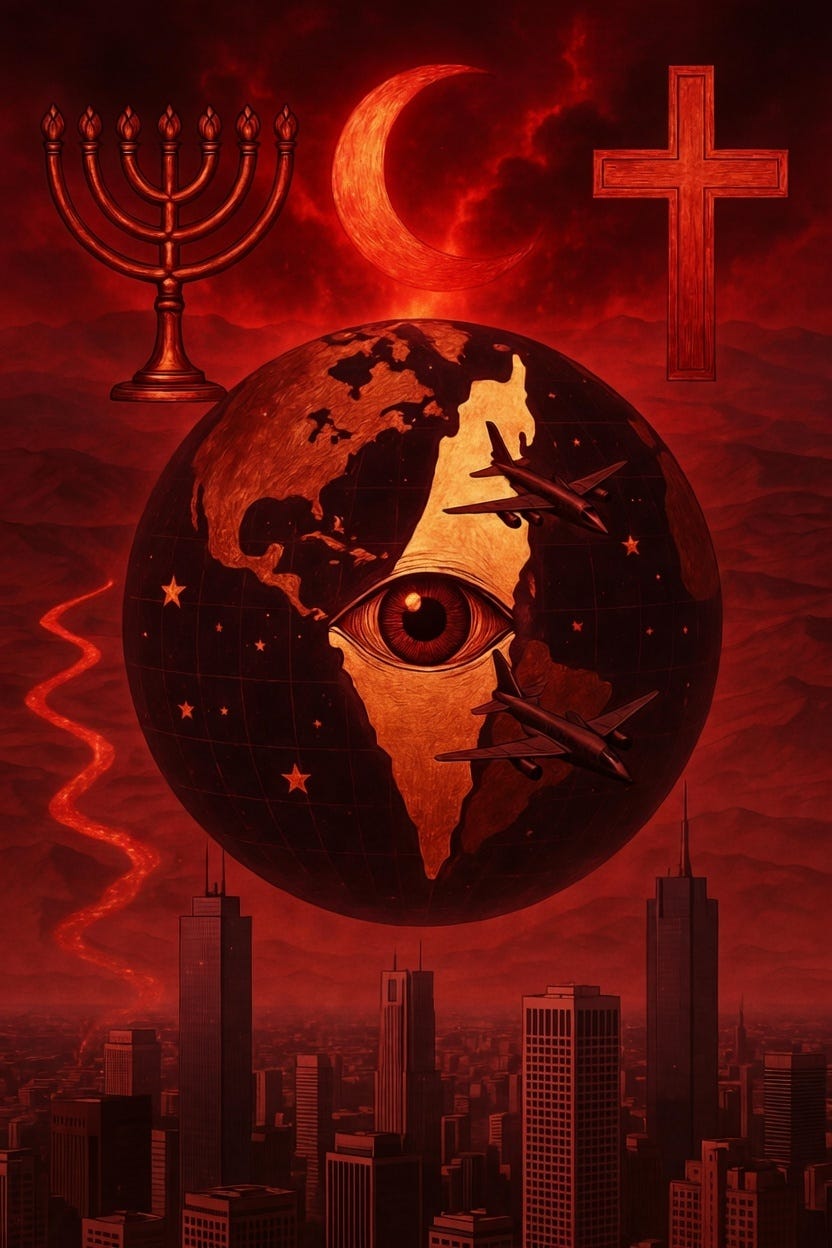
The first week of the current war against Iran produced a peculiar spectacle: an American president standing before cameras, searching for language to explain to his own citizens why the United States was at war with a country that had not attacked it. The explanations shifted. Nuclear threat. Regional stability. Support for an ally. None of it quite landed. The words kept sliding off the question. And that gap between the stated reason and the observable reality is where this essay begins.
Sun Tzu, in The Art of War, wrote that the supreme art of war is to subdue the enemy without fighting. The second best is to get someone else to do your fighting for you. The idea of using your enemy’s strength against itself, of maneuvering a more powerful adversary into exhausting its resources on your behalf, is not cynical statecraft invented in the modern era. It is ancient. What is less commonly discussed is whether it can be driven not just by strategy but by theology. Whether a country can be moved to fight another country’s wars not through coercion or even pure self-interest, but because a substantial portion of its political class genuinely believes that doing so is divinely required. That is the question this essay takes seriously.
The Alliance Nobody Wants to Examine Honestly
The relationship between the United States and Israel is regularly described in the language of shared democratic values, strategic partnership, and mutual interest. All of those things play a role. But they do not fully explain the consistency of American support, the breadth of it, or the willingness of successive administrations to absorb diplomatic and economic costs that a purely transactional calculus would not justify.
What does explain it, at least in part, is that tens of millions of American evangelical Christians have been told, and believe, that supporting Israel is a religious obligation. Not a geopolitical preference. A theological duty. This is not a fringe position. According to Pew Research data, between 63 and 80 percent of white American evangelicals believe that the establishment of Israel in 1948 was a fulfilment of biblical prophecy and a signal that the Second Coming is approaching.
A 2017 LifeWay poll found that 80 percent of evangelical Christians believed the creation of Israel was a prophecy-fulfilment that would bring about Christ’s return. Evangelicals make up roughly one-third of the Republican Party’s base. They vote together in a way that few other blocs do. They are not a peripheral constituency that politicians appease; they are a foundational one. When the current administration staffed senior foreign policy and national security positions with figures whose religious worldview places Israel at the centre of end times cosmology, this was a structural decision.
Since strikes on Iran began on February 28, 2026, the Military Religious Freedom Foundation, a watchdog group, reported receiving more than 200 complaints from service members across branches alleging that commanders had told troops the conflict with Iran was part of a divine plan, invoking biblical references to the end times.
This is not a small thing. Military officers interpreting an active war through prophetic scripture and communicating that to the soldiers under their command is something that would draw significant scrutiny if it happened anywhere else. In this context it passes as background noise.
Eretz Yisrael: The Map Underneath the Map
To understand the logic that follows, you need to understand what Greater Israel actually refers to, where it comes from, and who holds it as a serious political programme.
The concept of Eretz Yisrael HaShlema, or the Whole Land of Israel, has its deepest roots in the Hebrew Bible. The borders sketched in Genesis 15:18, Exodus 23:31, Deuteronomy 11:24, and Joshua 1:4 describe a territory extending from the Nile to the Euphrates River, encompassing portions of what are now Egypt, Jordan, Lebanon, Syria, and Iraq. For most of Jewish history this was understood as theological geography, something belonging to prayer and liturgy rather than political planning.
That changed with the rise of Zionism in the late 19th and early 20th centuries. Theodore Herzl, the movement’s founder, recorded in his diaries his vision for the Jewish state’s territorial scope. Revisionist Zionists, who evolved into what became the Likud party, never accepted the partition arrangements that Labor Zionists ultimately worked within. Their foundational ideology, rooted in the writings of Ze’ev Jabotinsky, held that both banks of the Jordan River and all the land between the sea and the river were historically and rightfully Jewish. This is not an interpretation of Likud’s origins; it is stated in the party’s foundational documents.
After the Six-Day War in 1967, when Israel captured the West Bank, Gaza Strip, Sinai Peninsula, and Golan Heights, the idea of Greater Israel moved from ideological background to active political programme. The settler movement was born in that moment, and it was explicitly messianic in its framing. Its leaders described the capture of these territories not as a military victory but as the beginning of a divinely ordained restoration. Gush Emunim, the religious settler movement of the 1970s and 1980s, held as doctrine that expanding Israel beyond its 1967 borders was not merely permissible but spiritually obligatory.
Today, maximalist territorial claims are made openly and without much embarrassment. Daniella Weiss, a prominent figure in the religious settler movement, said in 2024 that ‘the real borders of Greater Israel are the Euphrates and the Nile.’ In February 2026, Mike Huckabee, the United States Ambassador to Israel, told Tucker Carlson that it would be ‘fine’ if Israel took over the entire Middle East. Netanyahu himself has spoken of his ‘historic and spiritual mission’ and his attachment to the vision of Eretz Israel.
What exists in the occupied West Bank today, in Gaza, in Syria where Israeli forces have pushed beyond previously held lines, in Lebanon, is consistent with a step-by-step territorial consolidation. Whether it constitutes deliberate execution of a religious programme or simply opportunistic expansion rationalised after the fact by religious language is genuinely contested. It should also be noted that internal political constraints, coalition instability, and international pressures continuously shape the extent and pace of territorial policies. What is not seriously contested is that the programme exists, that it is openly advocated by members of the current governing coalition, and that it maps directly onto the biblical borders.
Gog and Magog: The Prophecy at the Centre
The theological structure that makes the current arrangement possible comes from the Book of Ezekiel, chapters 38 and 39, which describe a future catastrophic invasion of Israel by a northern coalition of nations led by a figure called Gog from the land of Magog. The coalition assembles against a restored Israel, living ‘without walls’ and in apparent security. The attack is devastating. And then God intervenes, destroys the invaders, and this event ushers in the messianic age.
According to Jewish Learning’s standard description of the prophecy, the wars of Gog and Magog have come to be understood as ‘a final battle between good and evil that will usher in a period of eternal peace.’ Interpretations vary widely, even among scholars of hardline Zionist theology, with some viewing the text more metaphorically than literally. The invaders are destroyed. The Jews bury the dead for months. God declares through the battle that the nations will know that He is holy in Israel. The restoration of the descendants of Jacob follows, the exiles are gathered back to the land, and a messianic era begins.
The Zechariah version of this prophecy, from chapters 12 and 14, adds specific geographic detail. The assault of Gog and Magog, in Zechariah’s vision, ‘will befall the Jews shortly after the messianic age has already begun, after the ingathering of the exiles.’ In other words, first comes the return. Then the rebuilding. Then the attack. Then the divine defeat of the attackers. Then the era of peace and, in some interpretations, the recognition by the nations of God’s sovereignty over Israel.
The critical structural point here is what does not happen in this prophecy. The United States is not mentioned. America is not part of the eschatological horizon. There is no role in Jewish end times theology for a dominant superpower that is also a close ally. The prophecy describes nations being humbled, enemies being destroyed, and Israel emerging as the centre of a new spiritual order. For the geography of the prophecy to work as described, the existing architecture of global power would need to be substantially different from what it is today.
The sequence matters. In both Ezekiel and Zechariah the conditions that precede the Gog and Magog war are specific: Israel must first be restored to the land, which religious Zionists mark as beginning in 1948. The exiles must be gathered, which is ongoing through aliyah. The land must be settled and productive, which is the explicit mandate of the settler movement. The Temple must be rebuilt, or at least its rebuilding must be imminent, which is why organisations like the Temple Institute in Jerusalem have spent decades preparing ritual objects, training a priestly class, and breeding the red heifers whose ashes Jewish law requires for purification before Temple service. These are not metaphors for these communities. They are a checklist.
Then comes the war. Gog leads a coalition against Israel, and in the hardline nationalist reading the identity of Gog has shifted across centuries, assigned variously to the Scythians, the Romans, the Ottomans, the Soviets, and now, in significant portions of the Israeli religious right, to Iran and its regional allies. The divine defeat of this coalition is not simply a military victory in the prophetic text. Ezekiel 38:23 describes the outcome as God magnifying and sanctifying himself in the sight of many nations, so that they shall know that he is the Lord. In the nationalist political theology that informs the current governing coalition, this translates into a post-war order in which Israel’s centrality is not merely asserted but recognised. Not lobbied for. Not negotiated. Recognised, by the nations, as the outcome of a visible divine act. That is a qualitatively different claim than any secular nationalism makes, and it explains why no diplomatic solution, no two-state arrangement, no internationally brokered compromise can satisfy the logic. The prophecy does not end in a treaty. It ends in acknowledgement.
That observation does not require attributing sinister intent to anyone. It simply notes that a consistent, internally coherent religious worldview held by the political movement currently governing Israel contains within it a logical endpoint that has no room for American hegemony.
The Art of War, Applied
Sun Tzu’s principles were not written as religious texts but as practical military doctrine. They have survived because they describe patterns of strategic behaviour that repeat across cultures and centuries. A few of them are worth examining here.
The first: use your enemy’s strength against him. The United States is the most powerful military force in the world. That power, deployed in the Persian Gulf region in support of Israeli objectives, serves to neutralise Iran, damage its regional allies, and reshape the Middle East I ways some observers argue align with the strategic interests of the Greater Israel project.. The Americans who make this deployment possible do so in many cases because they believe prophecy requires them to.
The second: allow your enemy to wear itself out. Every billion dollars spent on strikes against Iranian infrastructure, every carrier group in the Gulf, every American soldier told by a commander that they are participating in a divine plan, represents a drawdown of American capacity, credibility, and cohesion. The domestic fractures this war has opened in the United States, the protests, the budget arguments, the questions about democratic accountability, function precisely as Sun Tzu described: the opponent exhausts itself before the decisive confrontation.
The third: win the battle before it begins by shaping the terrain. The terrain in this case is not only geographic. It is political. A United States that has spent years and trillions in the Middle East, whose democracy is under internal stress, whose international reputation has declined, whose allies are frustrated, is a weakened version of itself. A weakened version is easier to eventually sideline.
None of this requires a conscious conspiracy in which Israeli officials gather to plan the downfall of their closest ally. It only requires that a religiously motivated political programme, consistently pursued over decades, produce outcomes that happen to serve both tactical interests and prophetic expectations. History is full of this kind of alignment. The actors believe they are doing one thing. The structural outcome is something larger.
What the War Is Doing to the Neighbourhood
Iran’s strategic response to being attacked has been to leverage geography. The Strait of Hormuz is the passage between Iran and Oman through which approximately 20 million barrels of oil move every single day. It handles roughly 20 percent of global petroleum trade. Its two shipping lanes are two miles wide in each direction, running along Iranian-controlled coastline.
The vulnerability this creates is not evenly distributed. The United States imports a negligible amount through Hormuz; only about 2.5 percent of total flows from the strait are bound for American ports, a reflection of domestic production that has made the U.S. largely self-sufficient. The exposure sits almost entirely in Asia. According to data from the U.S. Energy Information Administration and Q1 2025 figures, China alone accounts for 37.7 percent of all crude oil and condensate moving through the strait. India accounts for 14.7 percent. South Korea takes 12 percent. Japan takes 10.9 percent. Together, just four Asian countries account for 75 percent of oil and 59 percent of LNG flows through the chokepoint.
Japan is in a particularly exposed position. The country imports approximately 87 percent of its total primary energy supply, and fossil fuels generate over 60 percent of its electricity. Some 80 percent of Japan’s crude imports have historically transited the Strait. The country maintains government and industry stockpiles equal to roughly 180 days of crude demand, which provides a buffer, but not an indefinite one. A sustained disruption at $120 to $130 per barrel would push the Japanese economy into stagflation, according to independent modelling.
For China, the situation is structurally significant even if less immediately acute. Over 54 percent of China’s crude imports came from the Middle East in 2024. Russia provides a land-based alternative through pipeline, which reduces vulnerability somewhat. China has also built the world’s largest onshore crude stockpiles, estimated at 1.2 billion barrels as of January 2026. Still, the Atlantic Council has noted that China’s vulnerability will only ‘be substantially reduced in a few short years’ as electrification and domestic production increase. For now, effective closure of the Strait of Hormuz is a genuine threat to Chinese economic stability.
For Europe the picture is more complex. In 2025, EU countries imported only about 6 percent of their crude oil directly from the Middle East, having diversified substantially since the Russia-Ukraine war. The Economics Observatory noted in March 2026 analysis that the impact on Europe from the current conflict has been most pronounced not in direct supply disruption but in market pricing: natural gas futures for the UK and Netherlands have almost doubled following the initial strikes on Iran, with the Bank of England now likely to hold interest rates steady where cuts had previously been anticipated.
The Saudi desalination infrastructure, the Gulf data centres (including an Amazon facility destroyed in a recent strike), the Bahraini, Kuwaiti, Qatari, and Emirati ports that have all seen sharp falls in tanker movements since the strikes began, the insurance and freight costs that have surged accordingly: all of this constitutes a systematic degradation of the Gulf as a functional commercial zone. Tourists do not book holidays in active war zones. Businesses withdraw regional headquarters. The work of rebuilding investor and tourism confidence after a conflict of this scale typically takes years, sometimes decades.
What is left, when this ends, is a Middle East in which Iran has been damaged, the Gulf states have been destabilised, Arab neighbours of Israel have been weakened economically and in some cases militarily, and Israel, despite its own costs, holds a comparatively stronger regional position than before. This is not an accidental configuration. It maps with striking precision onto the preconditions the Greater Israel project requires: a neighbourhood too fractured to mount coherent opposition.
The Symmetry That Both Sides Ignore
The most intellectually interesting aspect of the current configuration is not that two religious traditions are each pursuing their prophetic endgame. It is that their endgames are, up to a certain point, completely compatible, and then suddenly, violently, are not.
Christian Zionism, in its dispensationalist form, requires Israel to exist, to expand, to occupy Jerusalem, to rebuild the Temple, and to become the site of a period of great tribulation. The return of Jesus Christ, in this theology, is contingent on Israel being present, powerful, and embattled. As Britannica’s description of dispensationalism notes, adherents believe that the establishment of Jewish sovereignty in the Levant is ‘a prerequisite for the Second Coming of Jesus Christ.’ Every Jewish settlement built, every square kilometre of the West Bank absorbed, every military victory moves the script forward.
What Christian Zionist theology does not mention, at least not prominently in its political incarnation, is what happens to the Jews once Christ returns. In the fuller version of the theology, the tribulation period involves enormous suffering for the Jewish people, the majority of whom perish. Those who survive are offered the choice of conversion or death. The Jews, in this telling, are instruments of a divine programme whose conclusion they themselves do not survive in recognisable form.
As an LSE undergraduate analysis put it bluntly: ‘Evangelical support for Israel is not about a love of Jews or Jewishness but a means to an eschatological end.’ In a documentary noted by scholars of the subject, Christian Zionist fundraisers who support Israeli settlement expansion were recorded stating openly and cheerfully that all Jews would burn and die after they fulfilled the prophecy. The Israeli settlers in the same film, aware of this, were described as smiling awkwardly and noting that they did not care as long as the money and diplomatic support kept coming.
That is a remarkable exchange. Two groups, each of which believes the other will eventually be destroyed, cooperating enthusiastically in the present because the current phase of both prophecies runs in the same direction. History provides numerous secular parallels for such high stakes “marriages of convenience.” The Molotov-Ribbentrop Pact of 1939 saw two regimes with diametrically opposed and mutually exclusive end-states cooperate to carve up Eastern Europe. Each side knew the other was an existential threat, yet both saw a temporary alignment as the most efficient way to clear their immediate strategic hurdles. Similarly, the current alliance between Christian Zionists and messianic nationalists functions as a joint venture in which both parties believe they are the ones using the other to reach a final destination that the partner will not survive.
The Jewish prophetic tradition, in its Zionist political expression, has its own trajectory. The ingathering of the exiles, the rebuilding of the Temple in Jerusalem, the war of Gog and Magog in which a great coalition of nations attacks Israel and is destroyed by divine intervention, and the subsequent messianic age in which, as Zechariah describes, ‘the nations shall know that I the Lord am holy in Israel.’ The precise content of this messianic age is not politically defined in mainstream Jewish theology, but in its hardline Zionist nationalist expression it includes a world in which Israel occupies the centre of spiritual, and by extension geopolitical, authority.
For that world to exist, the current architecture of global power cannot persist. A United States that remains the dominant military and economic force on the planet, with its own strategic interests and its own internal political dynamics, is not compatible with an Israel that serves as the world’s spiritual and political pole. It is not necessary to conclude that the Israeli political actors involved harbour active hostility toward the United States to recognise that they are comfortable with its eventual diminishment. Within this worldview, the United States is seen as a vital but temporary instrument, a “vessel” whose purpose is to provide the military and financial capital required to reshape the Levant. If the process of clearing the regional field results in the exhaustion of the American superpower, this is viewed not as a tragedy but as the natural closing of a chapter to make way for a new, Israel-centric order.
So both prophecies run together through the phase we are in now: expand Israel, degrade its neighbours, support its military operations, weaken the states that could threaten it. Then they diverge. In the Christian version, the Jews who remain alive at the conclusion convert or are killed and Christ rules from Jerusalem. In the Jewish messianic nationalist version, the nations are humbled, the Torah is the law of the land, and the Third Temple stands where the Dome of the Rock currently sits.
Neither side discusses this divergence when they meet at AIPAC dinners or evangelical solidarity rallies. It is the most significant fact about the alliance and the least examined one.
A Clarification That Matters
It is worth being precise about what is being described here, because precision matters when the subject is Jews, prophecy, and geopolitics, and the territory is heavily mined.
This is not a description of global Jewish behaviour or Jewish belief. The majority of the world’s Jewish population does not subscribe to messianic Zionist nationalism. Reform, Conservative, and most Modern Orthodox communities do not organise their political activity around the anticipation of a Third Temple or the fulfilment of Ezekiel 38. Many of Israel’s most trenchant critics are Jewish. The secular founders of the Zionist movement were largely indifferent to religious eschatology and motivated instead by the entirely secular logic of national self-determination in the wake of European persecution.
What this essay is describing is a specific political movement, Revisionist and now Religious Zionism, which holds the reins of Israel’s current government, whose members have made territorial and messianic statements in public, on camera, and in writing, and whose programme can be traced through observable policy.
Netanyahu’s coalition government includes figures who have called for the permanent ethnic cleansing of Gaza, the annexation of the West Bank, and the rebuilding of the Temple. These are not fringe positions within the current governing apparatus. They are ministerial positions. Itamar Ben-Gvir and Bezalel Smotrich hold cabinet level authority. Their views on territorial expansion and messianic mission are not concealed.
The observation being made here is that this specific political force, commanding the Israeli state, is pursuing objectives that are coherent within a religious framework, and that it is doing so with the assistance of an American political alliance that has its own religious framework, and that the two frameworks are complementary until they are catastrophically incompatible.
The persistence of this trajectory despite its logical risks to long-term American hegemony suggests a failure of the secular institutional immune system. While the “State Department” or the professional security establishment may operate on a purely realist calculus, they are often outmatched by the ideological fervour and voting cohesion of the religious blocs. In a democratic system where political survival depends on foundational constituencies, a coherent religious programme that provides clear, simple answers to complex regional problems can effectively “hijack” the machinery of the state. The secular institutions are then left to provide the technical justifications for a policy whose core motivation is not strategic, but eschatological.
The Price the World Is Already Paying
Iraq’s Deputy Prime Minister and Foreign Minister Fuad Hussein said in 2025 that oil prices could reach $200 to $300 per barrel if the Strait of Hormuz were blocked. JPMorgan analysts assessed the severe-case scenario at $130 per barrel, which would match the record oil shock of 2007 to 2008. At those prices, the consequences are not limited to energy bills.
Japan, South Korea, and Taiwan collectively hold strategic petroleum reserves of roughly 180, 210, and 120 days respectively, offering a buffer but not insulation from sustained disruption. China’s stockpile of 1.2 billion barrels provides several months of coverage at current consumption rates. But strategic reserves are by definition finite. They buy time. They do not solve the underlying supply problem.
Europe, despite its diversification away from Russian energy and its relatively low direct dependence on Middle Eastern crude, is vulnerable through pricing. Dutch TTF and UK NBP natural gas futures have nearly doubled since the opening strikes on Iran. The Economics Observatory’s March 2026 analysis describes this as a mechanism by which the conflict has ‘substantial effects on the global economy’ through countries that have no direct exposure to the region. Germany, France, and the UK do not import most of their oil from the Gulf. They do participate in global markets where Gulf disruptions set the price floor.
The desalination plants of the Gulf states, which provide drinking water for populations that could not survive without them, have been specifically threatened. The data infrastructure of the region, including an Amazon facility that served military purposes and was destroyed, is now explicitly targeted by Iranian military doctrine. Iran has also publicly threatened the data centres and office systems of major technology companies and banks following Israeli strikes on an Iranian bank.
All of this occurs while the United States spends, borrows, and debates. The costs of the war are distributed domestically across a society already fracturing over economic inequality, the healthcare system, and the question of what the country is for. Every trillion dollars directed toward military operations in the Gulf is a trillion dollars not spent on the domestic infrastructure, public health, and democratic institutional maintenance that a functioning superpower requires.
The Outcome Already Written in the Logic
The geopolitical outcome of the current trajectory, if it continues, is a Middle East in which Iran has been substantially degraded, the Gulf states have been weakened economically and militarily, the surrounding Arab nations are in varying states of dysfunction, and Israel, despite its own losses, has emerged as the dominant regional power, positioned to absorb territory and assert authority in a neighbourhood no longer capable of sustained resistance.
That is the Greater Israel project, not as conspiracy but as observable strategic logic. It is what Eretz Yisrael requires: a cleared field. The field is being cleared. The clearing is being done largely by American military and financial power, supplied by a political coalition whose religious beliefs make the clearing feel like righteousness rather than strategy.
Meanwhile the United States, having spent itself militarily and financially, having alienated its European allies with the unilateralism of this adventure, having deepened its internal political fractures, will emerge from this conflict diminished. Not destroyed. But diminished in the specific way that matters for prophetic logic: no longer unambiguously the dominant force in a world that Israel seeks to stand at the centre of.
This does not require anyone to have planned it. It requires only that a religious programme, consistently pursued, produces outcomes consistent with its own prophecy, and that an ally, animated by its own religious programme, enables those outcomes without recognising that its own vision of the future does not survive the next chapter.
The Conversation We Are Not Allowed to Have
What is happening in the Middle East right now is the most consequential geopolitical development in a generation. It is being enabled by an American political class significantly influenced by religious eschatology. It is being directed by an Israeli government whose leading members openly espouse messianic territorial goals. It is producing observable, measurable consequences for global energy markets, regional stability, and American institutional integrity. But you are not allowed to talk about it if it in any way places Israel in a negative or critical light.
None of this is antisemitic to observe. Antisemitism is the attribution of conspiratorial malign intent to Jewish people as a group. What is described here is the political programme of a specific government, driven by a specific ideological movement, operating within a specific religious framework. It involves no more attributing collective intent to Jews than describing Christian Nationalism involves attributing collective intent to Christians.
The symmetry of the two eschatologies, the phase of convergence and the point of divergence, is not a conspiracy theory. It is a structural observation about what two belief systems, both taken seriously by people with actual power, logically entail. If Christian Zionists are allowed to say openly that they support Israel because prophecy requires it, then the question of what prophecy requires of Israel itself is a legitimate analytical question.
The answer, if you read Ezekiel and Zechariah with the same literalness that American evangelicals bring to Revelation, is a world in which the nations that attacked Israel are defeated and humbled, in which the ingathering is complete, in which the Temple is rebuilt, and in which the nations of the world come to recognise the sovereignty of God as expressed through Israel.
That is a very different world from the one the Christian Zionists expect to inherit. And it is worth returning, at the close, to Sun Tzu. He wrote that the supreme victory is to win without fighting. The more precise formulation for the current situation is this: the supreme victory is to get your most powerful ally to fight your wars, weaken itself in the process, reshape the region you intend to dominate, and do all of it while genuinely believing that God asked them to. That is convergence, not a conspiracy. Two belief systems, each internally coherent, each pointing toward the same near term actions and toward mutually exclusive destinations from different directions. One of them will be surprised.
Thank you for this interesting essay. It explains a number of things that have been puzzling me. — Janice